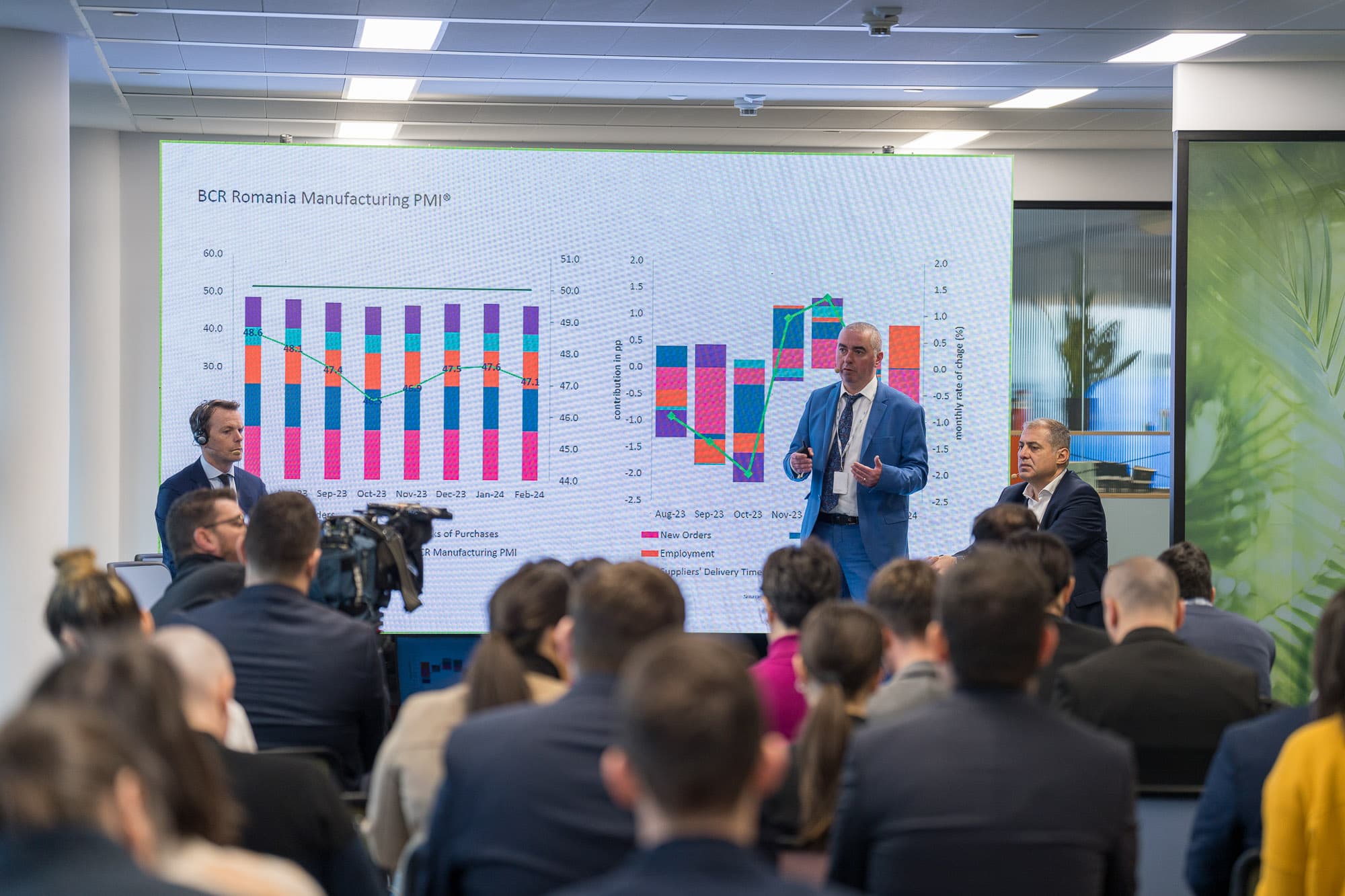
BCR Romania Manufacturing PMI® shows manufacturing production down at slightly sharper rate in November as underlying demand conditions remained weak
Faster decreases in output and new orders signalled - Levels of work outstanding and employment down again - Inflationary pressures cool
- Faster decreases in output and new orders signalled
- Levels of work outstanding and employment down again
- Inflationary pressures cool
Romanian manufacturers continued to contend with challenging operating conditions in November, as nearly all the PMI components remained in negative territory. According to the headline reading, there was little change in the strength of the downturn on the month. Production and new orders contracted at slightly faster rates compared to October. Meanwhile, there were ongoing signs of excess capacity as both backlogs and employment fell again, albeit only marginally. Reduced input requirements helped to ease cost pressures slightly, while charge inflation was only fractional.
The headline BCR Romania Manufacturing PMI® is a composite single-figure indicator of manufacturing performance derived from indicators for new orders, output, employment, suppliers’ delivery times and stocks of purchases.
A PMI reading above the 50.0 no-change mark signals an improvement in the health of the sector over the month, while a figure below 50.0 points to a deterioration.
At 48.0 in November, the PMI was little changed on the month (48.1 in October) and therefore remained in territory that signalled a modest deterioration in the health of the Romanian manufacturing sector.
Firms remained challenged by ongoing weakness in demand, as new orders weighed down on the headline index, having fallen slightly deeper into contraction. Linked to subdued market conditions and budgetary constraints at customers, the drop in order book volumes was solid in November. In part contributing to this was a marked and faster drop in new sales from international clients.
With sales conditions slipping further, manufacturers in Romania reduced their output volumes in November and to a slightly stronger degree than in October. Moreover, the rate at which production contracted was one of the sharpest seen for a year.
A lack of new orders meant that firms were able to run down their levels of outstanding work for a fifth month running in November. That said, a number of panellists did attribute the drop in backlogs to increased productivity at their plants. The rate of depletion was only marginal, however.
Further confirming spare capacity at Romanian manufacturers was another monthly decrease in workforce numbers in November, albeit one that was only marginal. This reflected attempts to re-align headcounts with workloads.
Purchasing quantities was another area of retrenchment in November, as input buying fell at the quickest rate seen since August. There were mentions of affordability issues in panel member reports.