NBI ANALYSIS | Bucharest Strengthens Its Position in CEE: Competitive Pricing, Limited Supply and Convergence Potential
Bucharest is entering a new stage of real estate market maturity. The pricing gap versus major Central and Eastern European capitals, a tightening residential supply pipeline and the strong performance of the hospitality sector are…
Bucharest is entering a new stage of real estate market maturity. The pricing gap versus major Central and Eastern European capitals, a tightening residential supply pipeline and the strong performance of the hospitality sector are strengthening the investment case for Romania's capital.
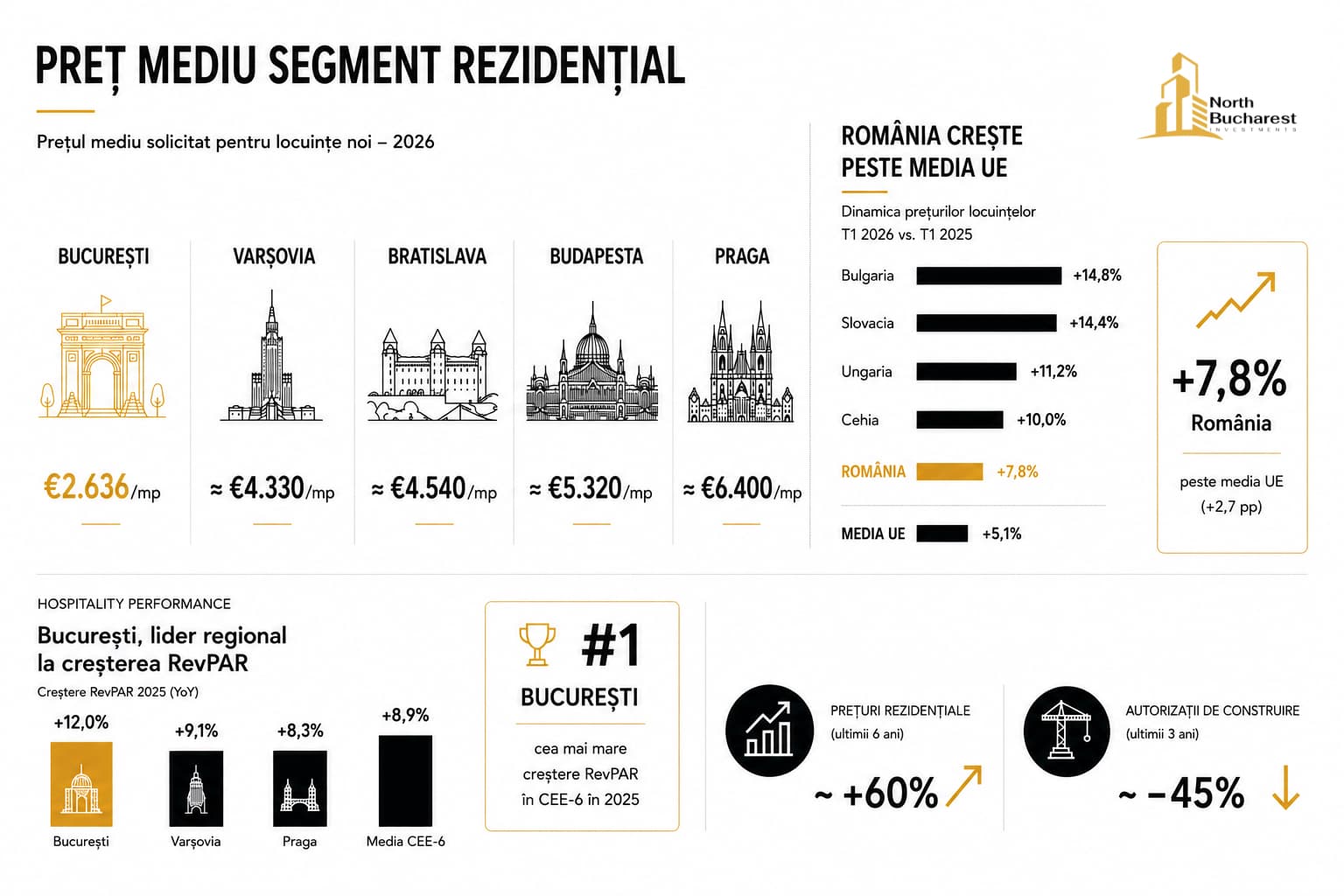
Bucharest's real estate market is undergoing an accelerated process of maturation at a time when investors are placing greater emphasis on the balance between entry price, asset quality, liquidity and long-term appreciation potential. Bucharest retains a significant advantage: residential values remain competitive compared with more mature CEE markets, while new supply is becoming increasingly difficult to replicate in established locations and segments such as premium residential and hospitality continue to develop rapidly. In 2026, the average asking price for new apartments in Bucharest reached approximately €2,636/sqm. By comparison, regional benchmarks for new residential properties indicate levels of approximately €4,330/sqm in Warsaw, €4,540/sqm in Bratislava, €5,320/sqm in Budapest and €6,400/sqm in Prague. Even after the appreciation recorded in recent years, Bucharest therefore maintains a competitive entry price compared with major CEE capitals, alongside meaningful convergence potential as the market continues to mature. The same trend is visible at macro level. In the first quarter of 2026, residential property prices in Romania increased by 7.8% year-on-year, above the 5.1% European Union average. While Romania is not leading the pace of appreciation in the region, the evolution confirms that the local market is participating in the broader repricing cycle across Central and Eastern Europe.
"Bucharest should increasingly be viewed within a regional context. The gap compared with capitals such as Warsaw, Prague or Budapest is not simply a pricing differential; it also indicates the convergence potential that Bucharest still has ahead. We have an increasingly sophisticated urban economy, a significant concentration of business activity, strong residential and investment demand and a growing hospitality sector, while real estate values remain competitive within the region. For investors, this creates an attractive equation, but the next cycle will not lift the entire market uniformly. Value will increasingly concentrate in well-positioned assets supported by infrastructure, efficiency, services and liquidity. The differentiator will no longer be the square metre alone, but the property's ability to generate and preserve value over time." said Vlad Musteată, CEO of North Bucharest Investments.