Professor Adrian Brady, president of the European Society of Radiology: The quality of work that I've seen presented from Romanian radiologists has been fantastic
This year's National Congress of Radiology and Medical Imaging in Craiova, supported by Siemens Healthineers, has brought on stage Romanian and international specialists to talk about the latest trends in the field. One of the guest…
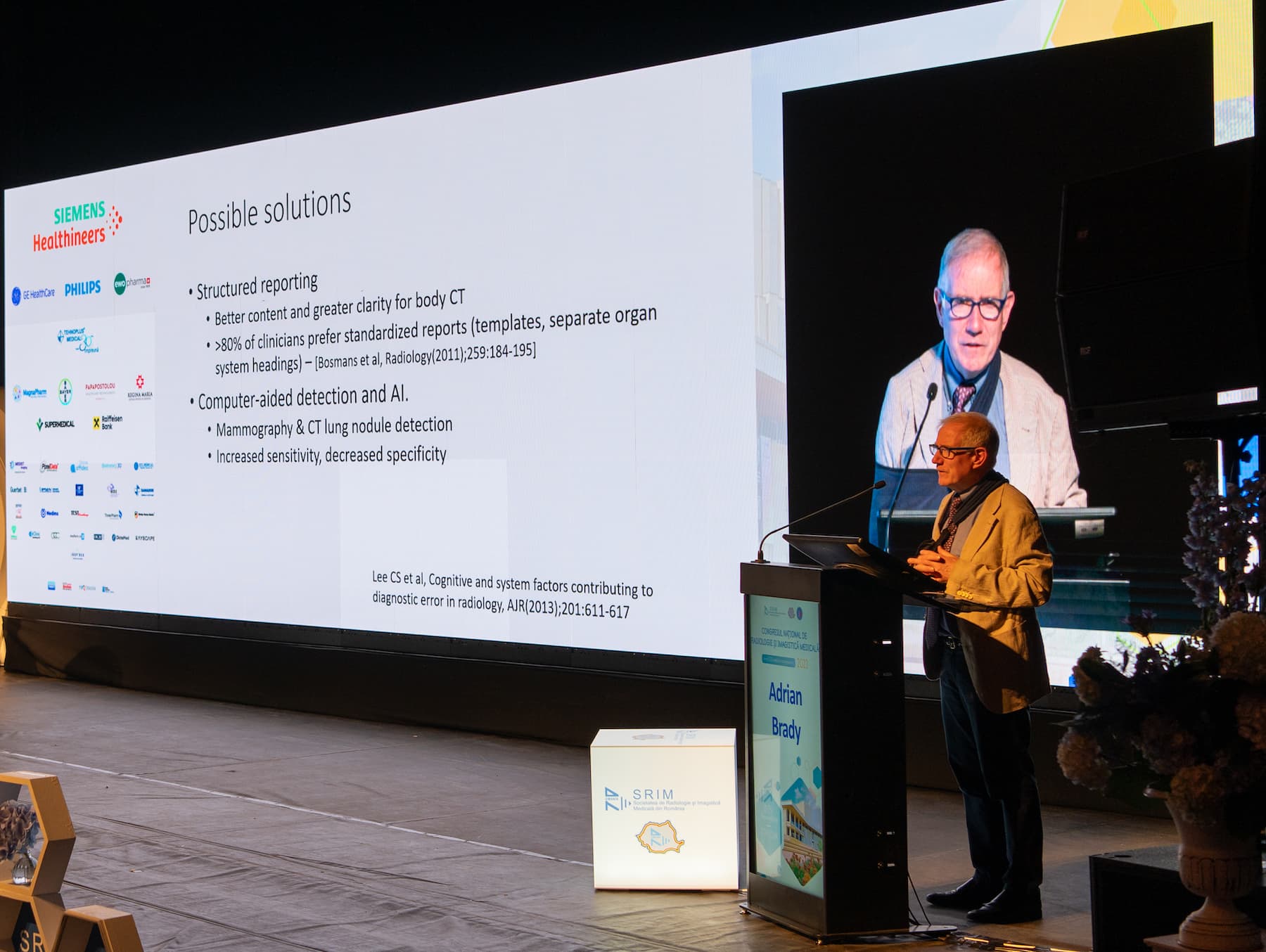
This year's National Congress of Radiology and Medical Imaging in Craiova, supported by Siemens Healthineers, has brought on stage Romanian and international specialists to talk about the latest trends in the field. One of the guest speakers, Adrian Brady, the president of the European Society of Radiology (ESR), says he was impressed with the quality of work presented at the congress by Romanian radiologists.
As technical developments have equipped radiologists to deliver better imaging, the demands imposed on them have increased as well, turning them into "almost a victim of their own success," Professor Adrian Brady, the president of the European Society of Radiology (ESR), says.
Developments such as AI-based solutions have opened up exciting possibilities but also a host of ethical implications that need to be considered.
Present at this year's National Congress of Radiology and Medical Imaging in Craiova, where he was among the speakers, Brady answered several questions on the challenges faced by radiology professionals, the latest trends in the field, and the work of the European Society of Radiology.
Part of the mission of the European Society of Radiology (ESR) is to unify European radiology. Could you tell us a bit about what this work entails and where the variations are?
Adrian Brady: Firstly, most countries have their own national radiology society - like the Romanian Society holding this congress, and they're fantastic - but we have found that there is also scope and need for a much larger society that brings together expertise from many different countries.
For example, you have great speakers at the session I've just been at from within Romania on cardiac CT, but professor [Christian] Loewe from Vienna is here as a representative of the European Society of Radiology, and he can bring something additional to the meeting.
So we found that there's really been a need for that sort of transnational education - number one.
Number two - another very important thing the ESR does is try to standardize education and educational standards. For example, the session that we had this morning with professor [Laura] Oleaga talking about the European Diploma of Radiology - this is something that the European Society has established in order to try and provide a benchmark that is exactly the same whether somebody takes the exam in Romania or Poland or Ireland, my country; it is a way of benchmarking one's knowledge, performance and training against everybody else in Europe.
And then, of course, by virtue of our size, we can leverage a lot of access to provide education that might not necessarily be available on a smaller scale. The congress we hold every year in March in Vienna is an example of that. We are able to draw people together from all over the world, not even just Europe, to provide the best educational opportunities that exist, and that is open to all ESR members. That is a resource that people find hugely valuable. We would usually have 18,000 to 20,000 people attending the congress coming from all over Europe, so they clearly find that valuable.