Jonathon Wragg, Head of Secondary at Cambridge School of Bucharest: We work hard to make sure that students reach their full potential
As Cambridge School of Bucharest continues its first year of offering parallel programmes in the last two years of Secondary school with both the International Baccalaureate (IB) and the British A-Levels, Jonathon Wragg, Head of Secondary…
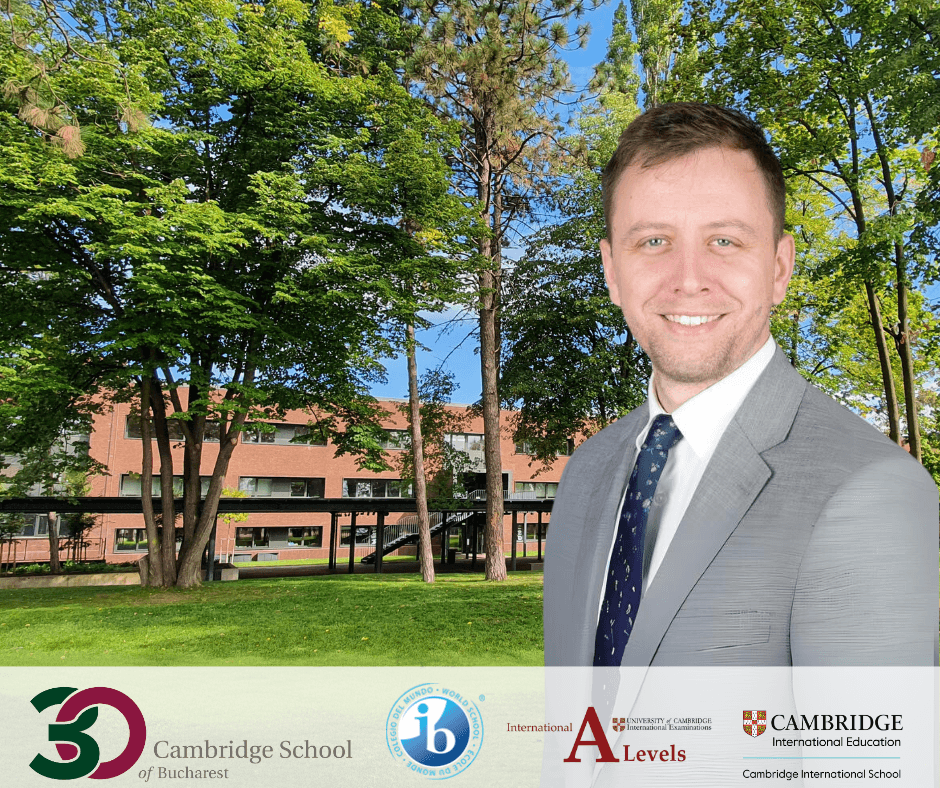
As Cambridge School of Bucharest continues its first year of offering parallel programmes in the last two years of Secondary school with both the International Baccalaureate (IB) and the British A-Levels, Jonathon Wragg, Head of Secondary school, explains what makes this offering so unique.
Can you tell us about your role as the Head of Secondary at Cambridge School of Bucharest?
Jonathon Wragg: It’s an exciting role with a diverse range of responsibilities. I get to work with students beginning their Secondary education in Year 7 all the way up to Sixth Formers planning their university applications. Whilst we have well-established systems that run through the school, every day brings something new – that’s what’s so great about the role.
This year, Cambridge School of Bucharest launched an IB Diploma Programme to run alongside the British A-Levels. What was the motivation behind this decision, and how do the two programmes complement each other?
Jonathon Wragg: The IBDP pathway is intended to complement our British A-Level pathway by offering an alternative approach to learning. Both are the gold-standard as international qualifications, but they cater to different types of learners. A-Levels, whilst flexible, offer deep specialisation through a narrower range of subjects. The IB, whilst providing specialisation, emphasises breadth and cross-curricular learning. The end result of either pathway is a world-class qualification, but we wanted to offer both styles of teaching and learning. Education doesn’t have to be one-size-fits-all!
For parents and students trying to decide between the IBDP and A Levels, what are some of the key differences between these two academic pathways?
Jonathon Wragg: Aside from the earlier point about breadth versus depth, there is also a significant difference in the structure of the school day. IB students have more contact time with teachers, in both structured lessons and supervised study time, and their timetables reflect this. British A-Levels require more independent study to complement fewer classes, and the resulting timetables have more free periods for students to utilise.
In addition, the IBDP requires that students draw links between their subjects and areas of learning, and this is built into their learning and assessments. This takes place in both their Theory of Knowledge course and their work on their ‘Extended Essay’. Though A-Level subjects do not require this level of interdisciplinary thinking, cross-curricular exploration can still offer significant benefits to all students.